A farmer’s harvest and a family’s dinner table shouldn’t be this far apart
South Africa’s government has cited estimates of about 10 million tonnes of food wasted each year, while the Department of Agriculture identifies market access as a continuing challenge for small-scale producers. Harvest Connect explores the connection between local supply and buyers.
By Thapelo Tlailana
Founder & Digital Solutions Specialist, Tswelopele Synergy Solutions
~10 million t
of food wasted each year, per estimates cited by government
01Two ends of the same table
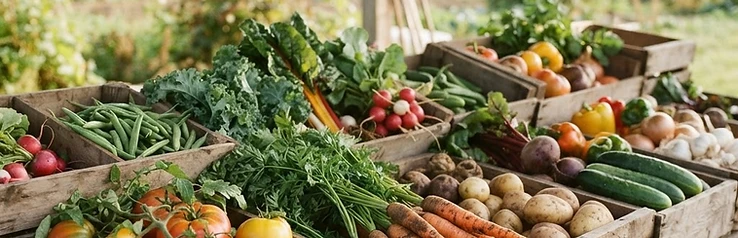
A farmer has a harvest ready and a limited window in which to sell it. Elsewhere, a household, a restaurant or a small retailer is looking for exactly that produce. Both sides are making an effort. Yet the two often fail to find each other in time, and the distance between them is less about kilometres than about information.
Harvest Connect starts from that gap. It asks whether a simple, local marketplace could shorten the distance between what is grown and what is bought.
02What the evidence says
South Africa’s government has cited estimates of about 10 million tonnes of food wasted each year, and the Department of Agriculture has identified market access as a continuing challenge for small-scale producers. Both frame the problem Harvest Connect responds to.
Food waste happens at many points: on the farm, in storage and transport, in retail and in households. A farmer-to-buyer marketplace addresses only one part of that chain, the connection between production and purchase. That focus on the connection between production and purchase is deliberate.
03Why discovery is harder than it looks
Fresh produce is perishable, so timing matters. A buyer needs to know what is available, how much, in what condition, where, and when it can be collected. A small producer may sell through a handful of regular channels or to whoever happens to stop by. Information about what is ready travels through calls, messages and personal contacts. It works, but only for the people already inside the network.
That is a discovery problem, and discovery problems are the kind a well-designed digital layer can ease. It is also why the product has to be simple: a farmer with a full day in the field will not maintain a complicated listing system.
04The question we asked
Could a simple digital marketplace make local produce easier to discover, and connect farmers directly with buyers before produce becomes waste?
05What Harvest Connect is designed to do
Harvest Connect is a prototype for farmer-to-buyer discovery and direct connections. Farmers list what they have available, buyers browse local supply, and the two connect directly. It is deliberately centred on local supply rather than a large central marketplace, because proximity can mean fresher produce and a simpler handover.
06The questions that decide whether it works
How little effort can a listing take? How should quantity, quality and availability be described so that a buyer can trust them? Who arranges transport, and how is it paid for? How should price information be shown without disadvantaging smaller producers? And how do we make sure the product works for farmers with limited connectivity rather than only for those already comfortable online?
These questions shape the workflow more than any single feature does, and they are the ones the prototype is built to test.
07A listing, from both sides
Imagine a farmer with a quantity of vegetables that will be ready in a few days. In the concept, the farmer records what is available, roughly how much, and when it can be collected. On the other side, a buyer browsing local supply sees it, sends an enquiry and agrees the details directly with the farmer.
Everything that matters is in that short exchange: what, how much, where, when and at what price. If the platform can make that exchange quick for both sides, it has done its job. If it adds steps, it has made the problem worse.
08Why local first
A local focus has clear advantages: shorter distances, simpler handovers and relationships that can build trust over repeat transactions. It also has limits. Harvests are seasonal and can arrive all at once, which means a local market can be saturated at the same moment every farmer has stock. Larger buyers may need volumes that one small producer cannot supply.
A local focus works best as one channel among several, alongside existing routes to market, and the pilot will show where it fits best.
09Measuring a pilot
For a pilot, the signals worth watching are practical: whether farmers keep listing after the first week, how quickly a listing turns into a conversation, and whether buyers return.
10What we are testing
The prototype covers farmer supply listings, buyer discovery, product information and the connection between the two sides. The next stage is a pilot with local farmers and buyers, focused on listing effort, response time and repeat use.
Harvest Connect
Local farmer-to-buyer marketplace exploring better connections between producers and buyers.